Project Introduction
This project focuses on the design of a self-sufficient, christian intentional community. While there is a focus on christian values and morals, most of the information herein should be applicable to any other group seeking to create a self-sufficient community.
Structure
This Project is broken into 3 sections:
- Introductory Pamphlet - Briefly introduce the concept by defining terms and goals.
- Technical Design - Examines technical aspects of building a self-sufficient community.
- Social Design - Examines the social aspects of building an intentional community.
Work in Progress
As a small warning, this document is not complete. It is being added to and reworked, so is liable to change from week to week. There almost certainly will be mistakes or inconsistencies that will eventually be fixed as work progresses.
Joining
If you are interested in helping with this project contact us via the information on the main website https://bendhacknslash.com.
Disclaimer
The information in this document is provided "as is", without warranty of any kind, express or implied, including but not limited to the warranties of merchantability, fitness for a particular purpose and noninfringement. In no event shall the authors or copyright holders be liable for any claim, damages or other liability, whether in an action of contract, tort or otherwise, arising from, out of or in connection with the software or the use or other dealings in the software.
Introductory Pamphlet
Defining Some Terms
To understand the topic better we should first define what we mean by a Self-Sufficient, Christian Intentional Community. Going over it phrase by phrase.
Intentional Community
What is an Intentional Community
Community is obviously the core concept of this idea. In these documents, “community” will usually refer to a local, small community of like-minded individuals that have closely meshed values. This is in contrast to other communities like the global community and the national community which both cover many people of differing values. The idea here is to set up a partition between the local community and other outside communities.
The idea of building a community somewhat separate from the greater national or global community is not new, rather it is a very old concept. Monasteries existed with the purpose to sequester it's members away from the outside world often dedicated to providing for themselves through their own labor. There have also been various social experiments, often called Communes, that have tried a similar separation many times throughout history with varying results.
However, both Communes and Monasteries have connotations in the modern consciousness. One of the more generic names for this kind of community is an Intentional Community: a community built intentionally whose members have a similar worldview and work closely with each other to maintain the community and further it's goals. "Intentional Community" helpfully provides a more generic term avoiding a specific governing philosophy or religious attachment.
An Intentional Community certainly could be communistic like the term commune implies to many, but it can also follow other governing and economic models. For example an Intentional Community could use an internal credit system to pay for things that can be redeemed for the national community's currency in which the community resides, or even just use cash of the nation directly if that poses no issues.
This book goes into detail on designing such an intentional community both from a social and technical point of view.
Why a Community?
Community is an important aspect of such an endevor. Just going out into the woods on your own is likely to result in suffering for several reasons:
-
Mental Health. Humans are social creatures that need other humans to have healthy meaningful lives. There is a reason solitary confinement is a punishment. Extended loneliness can damage the mental health of an individual at best making them miserable and at worse driving them insane.
-
Fragility. An isolated lifestyle would be very fragile, both in security from threats and ability to produce what you need. First if you get hurt, there is no one around to pick up the slack while you recover. Second, if you have to fight, numbers can be the difference between win or lose. Third, The ability to put multiple minds that can approach an issue from different directions creates better solutions. And finally the old saying “many hands make light work” holds true when tested.
-
Service. But most importantly, as Christians we are commanded to serve others in our daily lives; trying to fully isolate oneself would go against this.
Self-sufficient
What is "Self-sufficient"
Self-sufficiency is a focus of the technical section. That section will further lay out what self-sufficiency entails, and ways to make it work. For now, we will only define it briefly, and not look at the nuances. Just enough so you get an idea of this book's approach.
The term self-sufficient covers a range of meanings. On one end of the scale, you could mean that every last thing you use was made by you. On the other, you could be talking about making enough money to buy everything you need without going into debt. Our goal when we talk about being self-sufficient is somewhere in-between those meanings. For our purposes, we will define it as:
Self-sufficiency is a group freeing itself from critical dependence on outside sources.
By critical dependence we mean the ability to provide directly for our basic needs (water, food, health, shelter), the ability to build and maintain the systems that provide these, the ability to allow some innovation and leisure both via spare time and needed materials, and to produce a little bit more that can be profited from so we can buy what cannot be reasonably produced on our own. In short, we want to cover as much as possible ourselves while having the ability to buy a few things from outside the community.
In addition to that basic definition, our goal isn't to degrade our level of technology. The approach many pursuing self-sufficiency or "off-grid living" take is to drop back to a colonial/pioneer level of technology, thinking it is the only way to be self-sufficient. We should avoid that kind of thinking. All technology is man made, so we can understand how it works and make it ourselves, even if it is at a lower quality or not quite as convenient. But even better, we can alter these existing technologies to better fit our needs. Most technology today is designed with mass-production and efficiency in mind, we would rework them from the basic principles to favor systems that are flexible, easily built, and easily maintained.
The redesigned tools will likely be slower in production and not as efficient, but can be kept running by a small group of people. Modern technology is aimed at making things fast, and in large quantities. The trade off however is that these systems require specialists to maintain them while the products sometimes suffer in quality/durability/etc. Smaller scale systems exist, but are not popular as they do not fit into the need for mass production. However, we can engineer systems that would support the alternative paradigm that is a small self-sufficient community.
Why Self-sufficiency?
While not strictly necessary for this kind of endeavor, a community that can provide for itself is much more secure and independent then one that cannot. If something goes wrong within the community, the members can lean on the national community to help fix the issue via the nation's established economic and legal systems. However, if something goes wrong outside the community and the community is not self-sufficient, not only can members not help those in need around them, but the community itself is in danger.
Christian
This book is designed in a way that follows Christian values and looks at the design of a community from a Christian perspective. That said this book’s purpose is not to exhaustively define what a “Christian” is. A few side notes will be placed throughout the book, expanding on the topic at hand in a Biblical perspective, but that's it.
A very basic definition of Christianity can go as follows:
- The Bible is God’s word to us and reveals God and His plan for the world to us as well as Human nature.
- Because of the fall, Humanity’s natural state is sinful.
- Christ is divine and our only path of salvation is His freely given gift.
- Man’s primary purpose is to nurture a relationship with God and glorify Him.
- Man is also commanded to love and serve both God and their fellow humans regardless of if they are friend or foe.
- Man is commanded to follow certain rules and principles to uphold the high command of serving God and others all of which is revealed in the Bible.
Applying this to the topic at hand provides us with some immediate insights.
As Christians, we should avoid a complete decoupling from society. We are commanded to both bear a witness of Christ to the unsaved, and serve others to the best of our ability. We need to balance the isolation provided by creating an intentional community. The benefit of organizing into such a community is to facilitate individual and corporate Christian growth for all members, especially our children, in a safe environment with a tight knit group. The negative of such a group is, if we are not careful, to be too isolated causing a stunting of growth due to lack of conflicting ideologies and a lack of service to others. The internet and modern transport technologies provide a median option: Construct a Christian community designed to safeguard us and our children against corrupting influences, but, via trips to other communities and work through the internet, continue to share Christ to the greater world and help those in need.
As we design the social aspects of our community, point #2 is especially important. Understanding people will fail and designing paths for recovery from failures will be important. To try say that any failure is the worst thing possible is foolish and produces a proud, uncharitable group of people. However at the same time we do need to correct wrong behavior and not allow someone to continue along a path that is self harming. In essence, we need to be open and willing to forgive failure, but not be afraid to apply loving correction for the individual's good. Likewise designing safeguards that limit damages as much as possible is also important since we know people fail.
Point #4 should guides us in all we do for this endeavor, bringing God Glory.
Point #5 should guide us to have plans built in to help people outside the community when we can.
Other Important Terms
Here are a few more terms that will be used throughout the book. They will be defined when first used, but having them all in one place will likely be beneficial:
- Host Nation: A short hand for the nation hosting the community aka the nation that your community lands exist in and who have legal authority over the comunity.
Introductory Pamphlet
Defining Some Terms
To understand the topic better we should first define what we mean by a Self-Sufficient, Christian Intentional Community. Going over it phrase by phrase.
Intentional Community
What is an Intentional Community
Community is obviously the core concept of this idea. In these documents, “community” will usually refer to a local, small community of like-minded individuals that have closely meshed values. This is in contrast to other communities like the global community and the national community which both cover many people of differing values. The idea here is to set up a partition between the local community and other outside communities.
The idea of building a community somewhat separate from the greater national or global community is not new, rather it is a very old concept. Monasteries existed with the purpose to sequester it's members away from the outside world often dedicated to providing for themselves through their own labor. There have also been various social experiments, often called Communes, that have tried a similar separation many times throughout history with varying results.
However, both Communes and Monasteries have connotations in the modern consciousness. One of the more generic names for this kind of community is an Intentional Community: a community built intentionally whose members have a similar worldview and work closely with each other to maintain the community and further it's goals. "Intentional Community" helpfully provides a more generic term avoiding a specific governing philosophy or religious attachment.
An Intentional Community certainly could be communistic like the term commune implies to many, but it can also follow other governing and economic models. For example an Intentional Community could use an internal credit system to pay for things that can be redeemed for the national community's currency in which the community resides, or even just use cash of the nation directly if that poses no issues.
This book goes into detail on designing such an intentional community both from a social and technical point of view.
Why a Community?
Community is an important aspect of such an endevor. Just going out into the woods on your own is likely to result in suffering for several reasons:
-
Mental Health. Humans are social creatures that need other humans to have healthy meaningful lives. There is a reason solitary confinement is a punishment. Extended loneliness can damage the mental health of an individual at best making them miserable and at worse driving them insane.
-
Fragility. An isolated lifestyle would be very fragile, both in security from threats and ability to produce what you need. First if you get hurt, there is no one around to pick up the slack while you recover. Second, if you have to fight, numbers can be the difference between win or lose. Third, The ability to put multiple minds that can approach an issue from different directions creates better solutions. And finally the old saying “many hands make light work” holds true when tested.
-
Service. But most importantly, as Christians we are commanded to serve others in our daily lives; trying to fully isolate oneself would go against this.
Self-sufficient
What is "Self-sufficient"
Self-sufficiency is a focus of the technical section. That section will further lay out what self-sufficiency entails, and ways to make it work. For now, we will only define it briefly, and not look at the nuances. Just enough so you get an idea of this book's approach.
The term self-sufficient covers a range of meanings. On one end of the scale, you could mean that every last thing you use was made by you. On the other, you could be talking about making enough money to buy everything you need without going into debt. Our goal when we talk about being self-sufficient is somewhere in-between those meanings. For our purposes, we will define it as:
Self-sufficiency is a group freeing itself from critical dependence on outside sources.
By critical dependence we mean the ability to provide directly for our basic needs (water, food, health, shelter), the ability to build and maintain the systems that provide these, the ability to allow some innovation and leisure both via spare time and needed materials, and to produce a little bit more that can be profited from so we can buy what cannot be reasonably produced on our own. In short, we want to cover as much as possible ourselves while having the ability to buy a few things from outside the community.
In addition to that basic definition, our goal isn't to degrade our level of technology. The approach many pursuing self-sufficiency or "off-grid living" take is to drop back to a colonial/pioneer level of technology, thinking it is the only way to be self-sufficient. We should avoid that kind of thinking. All technology is man made, so we can understand how it works and make it ourselves, even if it is at a lower quality or not quite as convenient. But even better, we can alter these existing technologies to better fit our needs. Most technology today is designed with mass-production and efficiency in mind, we would rework them from the basic principles to favor systems that are flexible, easily built, and easily maintained.
The redesigned tools will likely be slower in production and not as efficient, but can be kept running by a small group of people. Modern technology is aimed at making things fast, and in large quantities. The trade off however is that these systems require specialists to maintain them while the products sometimes suffer in quality/durability/etc. Smaller scale systems exist, but are not popular as they do not fit into the need for mass production. However, we can engineer systems that would support the alternative paradigm that is a small self-sufficient community.
Why Self-sufficiency?
While not strictly necessary for this kind of endeavor, a community that can provide for itself is much more secure and independent then one that cannot. If something goes wrong within the community, the members can lean on the national community to help fix the issue via the nation's established economic and legal systems. However, if something goes wrong outside the community and the community is not self-sufficient, not only can members not help those in need around them, but the community itself is in danger.
Christian
This book is designed in a way that follows Christian values and looks at the design of a community from a Christian perspective. That said this book’s purpose is not to exhaustively define what a “Christian” is. A few side notes will be placed throughout the book, expanding on the topic at hand in a Biblical perspective, but that's it.
A very basic definition of Christianity can go as follows:
- The Bible is God’s word to us and reveals God and His plan for the world to us as well as Human nature.
- Because of the fall, Humanity’s natural state is sinful.
- Christ is divine and our only path of salvation is His freely given gift.
- Man’s primary purpose is to nurture a relationship with God and glorify Him.
- Man is also commanded to love and serve both God and their fellow humans regardless of if they are friend or foe.
- Man is commanded to follow certain rules and principles to uphold the high command of serving God and others all of which is revealed in the Bible.
Applying this to the topic at hand provides us with some immediate insights.
As Christians, we should avoid a complete decoupling from society. We are commanded to both bear a witness of Christ to the unsaved, and serve others to the best of our ability. We need to balance the isolation provided by creating an intentional community. The benefit of organizing into such a community is to facilitate individual and corporate Christian growth for all members, especially our children, in a safe environment with a tight knit group. The negative of such a group is, if we are not careful, to be too isolated causing a stunting of growth due to lack of conflicting ideologies and a lack of service to others. The internet and modern transport technologies provide a median option: Construct a Christian community designed to safeguard us and our children against corrupting influences, but, via trips to other communities and work through the internet, continue to share Christ to the greater world and help those in need.
As we design the social aspects of our community, point #2 is especially important. Understanding people will fail and designing paths for recovery from failures will be important. To try say that any failure is the worst thing possible is foolish and produces a proud, uncharitable group of people. However at the same time we do need to correct wrong behavior and not allow someone to continue along a path that is self harming. In essence, we need to be open and willing to forgive failure, but not be afraid to apply loving correction for the individual's good. Likewise designing safeguards that limit damages as much as possible is also important since we know people fail.
Point #4 should guides us in all we do for this endeavor, bringing God Glory.
Point #5 should guide us to have plans built in to help people outside the community when we can.
Other Important Terms
Here are a few more terms that will be used throughout the book. They will be defined when first used, but having them all in one place will likely be beneficial:
- Host Nation: A short hand for the nation hosting the community aka the nation that your community lands exist in and who have legal authority over the comunity.
Dangers
There are a number of dangers in this kind of endevor that we need to keep in mind before laying down our goals for the project.
Physical Harm
By relying on oneself for most things there will be an increased possibility for physical harm. This can come from needing to perform tasks that are inherently dangerous that the average person in a national community would not ever need to do. It is also possible that people in a self-sufficient lifestyle will have incomplete knowledge about a task they need to perform and harm themselves due to that.
This book plans to help with holes in people's knowledge so that they can safely perform related tasks along with avoiding inherently dangerous tasks as much as possible.
Echo Chamber
The specific goal of an Intentional Community is to collect like minded people into a group to work with each other and help each other grow in those values. However, this poses a real risk of creating an "echo chamber" environment. Such an environment is dangerous for several reasons.
- It stifles growth. If someone is never challenged in their beliefs, then when they invariably come across a conflict of philosophies, they will break rather then be capable of opposing the arguments against them.
- It stifles creativity. Creativity is helped by examining an idea from different viewpoints. If you are stuck always looking at a thing from one viewpoint you lose a significant amount of possible creativity.
We will try to design the social aspects to mitigate any Echo Chamber effects.
Abuse of Authority
Leadership is supposed to be a position of servitude. A good leader should maintain a healthy level of humility, putting aside their own wants and benefits to best lead the people they are placed over. Unfortunately leadership does have a certain amount of power associated with it, and power often draws in people that wish to use it for their own benefit.
As with any system where authority is held by a person over another, there is a risk of the leadership abusing it's authority. A large part of designing the social aspects will be in balancing how the leadership of the community is balanced against how they are able to act.
We have the benefit that it is harder to hide corruption when everyone personally knows each other and is able to discuss what is happening in the community. However, we also have the fault that a small community can more easily fall into nepotism if one family grows larger then the others, though this is nicely defeated if the community is fully made up of one extended family.
Financial Harm
As with any endeavor there comes a risk of financial harm. This should be kept in mind when we design the aspects of on-boarding, and off-boarding members of the community. We want to make sure that people leaving will be in a decent position to continue on with their lives outside of the community.
Goals
Project Design Goals
Keeping in mind both the defined terms and what dangers we may encounter, the goals guiding the development of this book is:
-
Design a social contract for the intentional community that builds onto the foundation provided by the host nation while striving to handle as much as possible “in house”, providing it’s members a way to manage the day to day administration of the community and resolve internal and external conflict as peacefully as possible.
-
Design technology that will allow the intentional community to be self-sufficient, providing it’s members with the basic needs of life as well as materials, tools, and support to pursue both personal and corporate projects.
-
To design everything with contingencies - so it is robust against disasters, conflict, and other sources of problems- and flexibility - so things have multiple uses and can bend to meet unusual demands.
-
To design in a way that balances individual freedom with corporate well-being.
-
To support the creation of multiple communities that can work cooperatively with each other, but still remain independent.
-
To not abandon technology just because one is going off-grid, but redesign it to support a the different paradigm that is self-sufficiency.
-
To balance separation and integration with those outside the community.
Community Goals
The goals for the resulting community are:
- Promoting the values set forth in the Bible.
- Promoting individual freedom and privacy within those values.
- Promoting corporate well-being within those freedoms.
- Promoting personal improvement.
- Promoting the pursuit and distribution of knowledge.
Technical Design
The Technical Design will deal with technology that can allow a community to be self-sufficient. However, these technologies vary depending on your situation, and are able to change as new scientific discoveries are made. As such, it is not really possible to exhaustively list out, or even explore all the best technologies for self-sufficiency, because each situation can have unique elements that the authors cannot think of, and even if we could make such a list it would quickly go out of date.
Instead a methodology that can be followed to re-purpose and develop technology is far more valuable. As such, the first half of the technical design will go over the methodology needed in designing technology for a self-sufficient community. The second half will look at a specific technology stack, stack meaning technologies from the lowest level to the highest each building on the previous.
You will then be able to use the methodologies learned in the first half to swap out obsolete or less efficient technologies that we lay out in the second half.
Self-sufficiency
Before describing the methodology we will follow, we need to establish our core goals. These goals fall nicely under the word "self-sufficiency", but just that word is a bit too broad to cover everything. We previously defined self-sufficiency very briefly, but we need to dive a bit deeper into what we mean by it.
Feel free to re-read the "Self-sufficient" section in the Terms chapter, but to recap what was already said:
Self-sufficiency is a group freeing itself from critical dependence on outside sources.
- We want self-sufficiency as a buffer against hard times and instability that a national community may face. If we are secure, we are in a better place to help those outside our community.
- We want our self-sufficiency to cover:
- Basic needs of food, water, health, and shelter.
- Create and maintain the tools needed to reasonably provide those items.
- Ability to provide for Innovation and Luxury items and activities, both in materials and time.
- Production of a few marketable products and/or services to make money for emergencies and goods we cannot reasonably produce ourselves.
- We want our technology level to remain comparable to modern society, even advancing as we work to improve it.
Lets look at this definition a bit closer, then cover each goal in more depth.
A Group, Outside Sources
In general, self-sufficiency as defined here can apply to a country, state, community, or homestead. Any of these groups can meet their core needs, while still trading outside the group for luxury type goods. Though smaller groups are harder to make self-sufficient due to lacking in division of labor. To allow self-sufficiency to work on smaller groups, people need to re-examine the technologies that work well for the national and global communities and scale it down or redesign it to function for smaller communities.
As for outside sources, it simply indicates any source outside the lines drawn for the intentional community.
Freeing Itself from Critical Dependence
By critical dependence, we mean the basic things that keep us alive. So food, water, shelter, and basic health needs. And by extension, we include the ability to build and maintain the tools to provide for those needs. Other things that are not as critical can still be depended on from other sources as they can be cut without the community coming to great harm. These are also often going to be difficult for the community to produce. And if the group produces a little extra, they can make money to acquire what is difficult or impossible to produce themselves. However, the goal is for the "difficult to produce" items to fall under luxury goods and that we focus on making production of our basic needs as easy as possible.
The Goals
A Buffer Against Instability
The world is a very connected place providing both benefits and drawbacks. On the one hand, we can produce stuff where it is easiest to make, then ship it around the world. This is the whole point of trade, cheap efficient production in one place providing cheap, solid goods where they are needed most.
On the other hand, whenever you centralize things they become more fragile. When the production of a particular product becomes concentrated in one place, it becomes easier for a single entity to control it. Likewise a single event is also more likely to disrupt the product, either at the point of production or during transport. While it is beneficial to produce products cheaply, it's also important to not have all the eggs in one basket, since if the basket gets dropped we will go hungry.
As such it is important that each area of the world be capable of providing for their basic critical needs. If a shipment is delayed, we can wait out the resulting shortage of cell phones, we cannot necessarily wait out the shortage of insulin, food, or any other such critical good.
Providing Our Needs
The basic needs are described as food, water, health, and shelter.
When we say "basic food", we are not talking about being able to provide everyone their favorite food, or even a variety of foods. Those both fall under Luxury. However, we also don't mean making enough of a single food to fill us each day, like how rice is used in many Asian countries. What we mean is the ability to provide nutritionally balanced meals each day that can allow people to grow up and live healthily, with enough variety to work around food allergies. Anything beyond that requires individuals to put in extra work during their free time to provide.
When we talk about "basic water", we mean both potable water that is safe to drink, as well as sufficient water for growing plants and tending to animals.
When we say "basic health", we are talking about the ability to tend to common and long-term critical ailments. Not just disinfecting and binding cuts, tending to bruises, antibiotics for bacterial diseases, and the ability to identify these issues, but also things like providing insulin and other basic drugs that are well known preventative measures for long standing illnesses. However, we are not expecting to be able to handle complicated surgeries or developing vaccines. Even so this point will probably be the hardest to do well and safely.
When we talk about "basic shelter", we are not simply meaning a roof over one's head. It is important that we can build our own structures that are strong and able to house us, our animals, and our tools. But we are also talking about the ability to ward off all the elements. The ability to both heat and cool our interior spaces as well as the ability to control dust, pollen, and other air quality issues. Finally, protection from others is also included under shelter with being able to fence in our community and produce weapons.
The Tools to Provide
Providing these basic needs is critical. But it's also important that you can make the tools that produce those needs. You can get away without this, but it could be a bit rough. For one some companies, especially for things like tractors, have been trying to restrict people from repairing the products themselves, demanding "qualified technicians" in the employ of the company be the only legal way to repair. Essentially they are trying to place a monopoly on the repair market. Another point to consider is the fact that we are adjusting the technologies we use to better fit a small community, which is likely to use at least some parts that cannot simply be acquired off the shelf. Finally, it further builds up that safety buffer if we are able to fabricate our own tools.
To put it simply, it's likely a good idea to include the ability to build one's own tools, but if necessary a community could manage without this.
Innovation and Luxury
Innovation is important so we don't stay stagnant. We should constantly work to improve the technologies we use, bit by bit. Making our tools and toys more efficient and easier to use.
Likewise Luxury is important. When we say Luxury we mean things not core to survival like free time and one's favorite food. In short production of nonessential items and leisure time.
Marketable Products/Services
We don't expect it to be possible to make everything. Beyond that, we also have things that would be too dangerous to handle ourselves, for example delicate surgeries or dealing with especially dangerous substances. For both of these we will need to produce a product or service we can sell outside the community. This can be most anything, from art to video games to farm fresh produce, but whatever it is it would be beneficial if the group did it together as another method to grow together.
In addition if the community uses money internally to facilitate interactions between members, this is a useful way to add more to the pool.
Level of Technology
Free time is very important to the ability of people to take part in Innovation and Luxury. By maintaining a high level of technology, each person will be-able to work less and have a bit more free time to peruse secondary concerns. In addition, keeping a more advanced level of technology is safer. It will allow us to treat illnesses and accomplish otherwise dangerous tasks with greater safely.
Note: A Christian View of Self-sufficiency
From a Christian perspective, "Self-sufficient" or "self-dependent" are used as negative terms applying to people who attempt to live without God. However, by using the term self-sufficient in the context of this project we intend to make a temporal (human-human) statement not spiritual (human-God). Hopefully this would actually push one to be more reliant on God, since individuals can work closer to God’s creation instead of being constantly surrounded by sub-creation, that which is made by man, but knowing human nature this can easily be twisted into pride of one's own accomplishments and is an issue of which Christians must be careful.
Self-sufficiency
Before describing the methodology we will follow, we need to establish our core goals. These goals fall nicely under the word "self-sufficiency", but just that word is a bit too broad to cover everything. We previously defined self-sufficiency very briefly, but we need to dive a bit deeper into what we mean by it.
Feel free to re-read the "Self-sufficient" section in the Terms chapter, but to recap what was already said:
Self-sufficiency is a group freeing itself from critical dependence on outside sources.
- We want self-sufficiency as a buffer against hard times and instability that a national community may face. If we are secure, we are in a better place to help those outside our community.
- We want our self-sufficiency to cover:
- Basic needs of food, water, health, and shelter.
- Create and maintain the tools needed to reasonably provide those items.
- Ability to provide for Innovation and Luxury items and activities, both in materials and time.
- Production of a few marketable products and/or services to make money for emergencies and goods we cannot reasonably produce ourselves.
- We want our technology level to remain comparable to modern society, even advancing as we work to improve it.
Lets look at this definition a bit closer, then cover each goal in more depth.
A Group, Outside Sources
In general, self-sufficiency as defined here can apply to a country, state, community, or homestead. Any of these groups can meet their core needs, while still trading outside the group for luxury type goods. Though smaller groups are harder to make self-sufficient due to lacking in division of labor. To allow self-sufficiency to work on smaller groups, people need to re-examine the technologies that work well for the national and global communities and scale it down or redesign it to function for smaller communities.
As for outside sources, it simply indicates any source outside the lines drawn for the intentional community.
Freeing Itself from Critical Dependence
By critical dependence, we mean the basic things that keep us alive. So food, water, shelter, and basic health needs. And by extension, we include the ability to build and maintain the tools to provide for those needs. Other things that are not as critical can still be depended on from other sources as they can be cut without the community coming to great harm. These are also often going to be difficult for the community to produce. And if the group produces a little extra, they can make money to acquire what is difficult or impossible to produce themselves. However, the goal is for the "difficult to produce" items to fall under luxury goods and that we focus on making production of our basic needs as easy as possible.
The Goals
A Buffer Against Instability
The world is a very connected place providing both benefits and drawbacks. On the one hand, we can produce stuff where it is easiest to make, then ship it around the world. This is the whole point of trade, cheap efficient production in one place providing cheap, solid goods where they are needed most.
On the other hand, whenever you centralize things they become more fragile. When the production of a particular product becomes concentrated in one place, it becomes easier for a single entity to control it. Likewise a single event is also more likely to disrupt the product, either at the point of production or during transport. While it is beneficial to produce products cheaply, it's also important to not have all the eggs in one basket, since if the basket gets dropped we will go hungry.
As such it is important that each area of the world be capable of providing for their basic critical needs. If a shipment is delayed, we can wait out the resulting shortage of cell phones, we cannot necessarily wait out the shortage of insulin, food, or any other such critical good.
Providing Our Needs
The basic needs are described as food, water, health, and shelter.
When we say "basic food", we are not talking about being able to provide everyone their favorite food, or even a variety of foods. Those both fall under Luxury. However, we also don't mean making enough of a single food to fill us each day, like how rice is used in many Asian countries. What we mean is the ability to provide nutritionally balanced meals each day that can allow people to grow up and live healthily, with enough variety to work around food allergies. Anything beyond that requires individuals to put in extra work during their free time to provide.
When we talk about "basic water", we mean both potable water that is safe to drink, as well as sufficient water for growing plants and tending to animals.
When we say "basic health", we are talking about the ability to tend to common and long-term critical ailments. Not just disinfecting and binding cuts, tending to bruises, antibiotics for bacterial diseases, and the ability to identify these issues, but also things like providing insulin and other basic drugs that are well known preventative measures for long standing illnesses. However, we are not expecting to be able to handle complicated surgeries or developing vaccines. Even so this point will probably be the hardest to do well and safely.
When we talk about "basic shelter", we are not simply meaning a roof over one's head. It is important that we can build our own structures that are strong and able to house us, our animals, and our tools. But we are also talking about the ability to ward off all the elements. The ability to both heat and cool our interior spaces as well as the ability to control dust, pollen, and other air quality issues. Finally, protection from others is also included under shelter with being able to fence in our community and produce weapons.
The Tools to Provide
Providing these basic needs is critical. But it's also important that you can make the tools that produce those needs. You can get away without this, but it could be a bit rough. For one some companies, especially for things like tractors, have been trying to restrict people from repairing the products themselves, demanding "qualified technicians" in the employ of the company be the only legal way to repair. Essentially they are trying to place a monopoly on the repair market. Another point to consider is the fact that we are adjusting the technologies we use to better fit a small community, which is likely to use at least some parts that cannot simply be acquired off the shelf. Finally, it further builds up that safety buffer if we are able to fabricate our own tools.
To put it simply, it's likely a good idea to include the ability to build one's own tools, but if necessary a community could manage without this.
Innovation and Luxury
Innovation is important so we don't stay stagnant. We should constantly work to improve the technologies we use, bit by bit. Making our tools and toys more efficient and easier to use.
Likewise Luxury is important. When we say Luxury we mean things not core to survival like free time and one's favorite food. In short production of nonessential items and leisure time.
Marketable Products/Services
We don't expect it to be possible to make everything. Beyond that, we also have things that would be too dangerous to handle ourselves, for example delicate surgeries or dealing with especially dangerous substances. For both of these we will need to produce a product or service we can sell outside the community. This can be most anything, from art to video games to farm fresh produce, but whatever it is it would be beneficial if the group did it together as another method to grow together.
In addition if the community uses money internally to facilitate interactions between members, this is a useful way to add more to the pool.
Level of Technology
Free time is very important to the ability of people to take part in Innovation and Luxury. By maintaining a high level of technology, each person will be-able to work less and have a bit more free time to peruse secondary concerns. In addition, keeping a more advanced level of technology is safer. It will allow us to treat illnesses and accomplish otherwise dangerous tasks with greater safely.
Note: A Christian View of Self-sufficiency
From a Christian perspective, "Self-sufficient" or "self-dependent" are used as negative terms applying to people who attempt to live without God. However, by using the term self-sufficient in the context of this project we intend to make a temporal (human-human) statement not spiritual (human-God). Hopefully this would actually push one to be more reliant on God, since individuals can work closer to God’s creation instead of being constantly surrounded by sub-creation, that which is made by man, but knowing human nature this can easily be twisted into pride of one's own accomplishments and is an issue of which Christians must be careful.
Retaining a Modern Infrastructure
Modern Technology
In the past things were built manually one at a time on a case by case basis. This often, not always, resulted in high quality products that lasted a very long time (often multiple generations), but was slow allowing only a small amount of products to be made, and each product was expensive. When something broke, you got it fixed, because it was cheaper and worth it over buying new.
The industrial revolution brought about mass production via specialized machines which in turn made it viable to create many products at a lower quality, where a user could discard the product and pick up a new one cheaply. So our economy today has a large focus on moving products quickly into and back out of people's hands. People buy products and, depending on the product, either use them once then throw away or replace them every one to five years. Part of this is due to rapid development, I.e. a phone from this year has slightly better features over one from last year. It also has a lot to do with convenience, for example wiping up a spill with a paper towel and tossing it is easier then with a cloth and needing to wash it later.
So a lot of our technology is optimized around mass-production and producing disposable objects. This has benefits and draw backs. Products are cheap and people can easily acquire whatever they want, but things are lower quality and need regular replacing. These are not desirable traits for people making their own stuff. We do not need a lot of items, and we would prefer that our items last. However at the same time, we would rather not go back to time, skill, and labor intensive processes to produce our items. It would be better to bring the old mentality and apply new tools to it.
For us to merge the two, we need to sketch out how things are done now, and how we need to change them with the old mentality in mind to get our new methodology.
Simplified Modern Infrastructure
I'm going to break Modern Infrastructure, the set of tools which provide for our wants and needs, into 3 layers with 5 parts and arrange them into a pyramid shaped diagram like the below image.
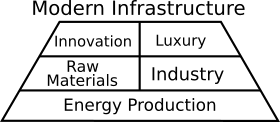
- At the pyramid's base is usable energy and the technologies that produce it. Without energy society does not have the ability or time for advanced infrastructure.
- Built on top of energy is the ability to both acquire raw materials and use them to make useful items.
- All of that lays down the supports for innovation and luxury positioned at the top.
A self-sufficient community should follow this infrastructure but scale it to the community's size. Power sources should be producible and repairable by the community, processes for producing things should match the scale that the community needs, and producing raw materials should be done in a way the community can support without undue strain on it's people.
Energy Production
Energy production and manipulation is essential to self-sustainability. Without a source of energy, providing for the most basic needs becomes life dominating; without multiple sources of energy, our self-sufficiency will be fragile. Energy harnessed into usable forms is what allows for technology to force multiply people’s work. And technology without the energy to power it is nigh worthless.
We need to keep in mind our capabilities and the natural resources at our disposal. Depending on the geography, latitude, wind speeds, and such. If you have flowing water, then hydro-electric is a really good idea. If you have good wind speeds, a windmill might be the way to go. Solar is readily available most place, though is not consistent which means you need more robust storage.
We should also remember to consider technologies that are often overlooked by society at large due to it not fitting into the modern paradigm of mass-production. Methane Digesters are a decent example, they produce a gas mix similar to natural gas and decent fertilizer from animal manure and organic matter. So if you raise animals you could take waste hay and menure and produce a burnable gas while getting good fertaliser a lot faster then composing can do.
Finally, it will also be important to look for technologies that can make a previously useless resource, usable. For example there has been work to try and build a generator that works on low wind speeds, one example can be seen in a project from 2012 called the Wind Harvester which can supposedly work both close to the ground and with low wind speeds.
Once we build a solid base of energy generation, we can move onto providing for our needs.
Raw Materials and Industry
The next level up deals with acquiring raw materials and processing them into usable things. This includes providing for all of our basic needs and the tools to do so.
Raw Materials
Growing plants and raising animals are both readily available ways to create new raw materials. There is obviously the food aspect and direct materials like cotton that can become cloth, but also the many side products we could use. Side products like manure that has a few uses, especially as fertilizer, and inedible plant matter that can either help feed animals or be processed to provide useful chemicals. We should maintain a mentality of using every scrap of the things we produce as efficiently as possible.
To make the most of this, it's important to pick the right animals and plants. It might not be best for some small groups to try and raise cattle as their main source of meat, and instead focus on a mix of smaller animals like rabbits, chickens, and goats as some examples. Focusing on a variety of plants that can grow close together and complement each other is better then trying to grow a mono crop, and you can extract a greater variety of resources from them as well. We need to move away from mass production farming and build ecosystems that complement each other and result in a number of usable products.
Other raw materials are also important. Metals are probably the hardest raw materials for a small scale community to make. We need to go back once again and re-examin technologies that society at large have ignored. For example, Red Clay (Ultisol) that is prevalent in the southeast of the USA is chock full of iron, aluminum, and various minerals. There are ways to extract aluminum from clay that may work for Red Clay via a closed loop sulfuric acid system. Similarly there is a bacteria colloquially called Iron Bacteria that is a nuance to many people making their well water taste bad, but was successful used by Primitive Technology, a YouTube channel dedicated to building primitive tools, to extract iron and make a simple knife. These and other things like them may be good ways to produce a little bit of metal for use in the community.
Finally, we might consider focusing on salvage. Rebuilding other people's trash into usable tools. While often not a profitable thing to do, it is a way to acquire materials for free or at least very cheaply.
Industry
With raw materials covered, we are now on the processing side of things. Like with everything else it is good to keep in mind that many industrial production methods in the modern industry sector are focused on mass production, and are not really suitable for a community like we are trying to build. Modern production focused machines are often hyper specific automated systems, like a chain maker. It makes a chain and only a chain and often only a small range of gauges at that. They can mass produce the item with no real skill needed, but can only make the one item and has no flexibility.
We also should try to reduce the need for high skill, manual processes. We don't want to rely purely on hand tools, and many other tools like lathes need a certain skill to use. It is good to have both hand tools and manual electric tools and train people with them, but it is probably best to design the production of our core needs around automated tools as much as possible. Automated tools like 3D Printers, CNC mills, and the like.
These computer controlled systems are a nice balance of automation and flexibility. You still need design skills to use these tools, but the fabrication process is quite a bit lower skill. Plus the design is only needed to be developed once, then you just input materials and they fabricate the design repeatedly. And they are quite flexible also good at making a wide range of items instead of a single thing. Hand and manual electric tools are still more flexible, but the automation is worth while trade off.
Innovation and Luxury
Once Energy, Raw Materials, and Processing of those materials are all sorted out, you can figure out how much free time is left over week to week. This free time is a great resource in and of itself allowing us to pursue Innovation of our tools and Luxury items.
Innovation is obviously important as we should always be working on improving our tools. People can either focus on specifically improving tools that are being used, or experiment with ideas that may or may not turn into a new, better technology. It is also good to note that a large part of this is collaboration, both with other like-minded communities that are trying to pursue better self-sufficiency tools, and with the greater global community on more general open source software and hardware.
Luxury is also important. When we talk about Luxury we mean a mix of leisure time and the production of non-essential goods. Leisure time is important to reduce stress and recharge. It helps keep people fresh, improves the groups cohesion both through bonding via play and reducing the chance a person will needlessly snap at others, and is overall important to one's mental health. Luxury items are nice things to have that while not critical for day to day survival, are still very useful. Spending time creating art, building toys, and otherwise creating various forms of entertainment.
Social Design
Purpose for the Social Design
The social design has several purposes.
First, the social design exists to Prevent External Strife, issues with those outside the community. The community's purpose is not to replace the nation, but to build an identity within, one of many that make up the whole nation. We do this by leveraging the nation's legal system to build a legal identity within the nation. This identity allows the community to legally govern itself, provide a buffer between it's people and those outside the community, and prevents causing issues with the host nation as some sort of identity that is compeating with the nation instead of being a subset of it.
Second, the social design exists to Prevent Internal Strife, issues between people within the community. Prevention is preferable to punishment, and the design needs to have a heavy emphasis on catching and dealing with problems before they happen.
Third, the social design exists to Dictate Acceptable Punishments so we know how to handle issues that have already occured. Inevitably something will happen that must be addressed, and we need to have paths already in place. Our resolutions must work within the legal system of the nation, but when they have no clear stance on something we need to promote a healthy balance of justice and mercy.
Finally, the social design exists to Dictate Day to Day Operations, so we have clear guidelines on how to keep the whole system running. We need to know who has what position and what tasks they are and are not responsible to handle. We need people to be balanced against each other and informed of each others decisions to prevent corruption. And we need clear processes for handling emergencies.
The Result
The social design should result in a charter that is a legal document within the host nation and should explicitly detail:
- Admittance Requirements
- Handling Departures
- Community Rules and Punishments for Infringements
- Governance
(TODO likely more areas are needed, this list is an off the top of my head deal)
This design should first be put to plain language, then will need to be put into legal language via a lawyer with a contract that all community participants current and future will sign.
Social Design
Purpose for the Social Design
The social design has several purposes.
First, the social design exists to Prevent External Strife, issues with those outside the community. The community's purpose is not to replace the nation, but to build an identity within, one of many that make up the whole nation. We do this by leveraging the nation's legal system to build a legal identity within the nation. This identity allows the community to legally govern itself, provide a buffer between it's people and those outside the community, and prevents causing issues with the host nation as some sort of identity that is compeating with the nation instead of being a subset of it.
Second, the social design exists to Prevent Internal Strife, issues between people within the community. Prevention is preferable to punishment, and the design needs to have a heavy emphasis on catching and dealing with problems before they happen.
Third, the social design exists to Dictate Acceptable Punishments so we know how to handle issues that have already occured. Inevitably something will happen that must be addressed, and we need to have paths already in place. Our resolutions must work within the legal system of the nation, but when they have no clear stance on something we need to promote a healthy balance of justice and mercy.
Finally, the social design exists to Dictate Day to Day Operations, so we have clear guidelines on how to keep the whole system running. We need to know who has what position and what tasks they are and are not responsible to handle. We need people to be balanced against each other and informed of each others decisions to prevent corruption. And we need clear processes for handling emergencies.
The Result
The social design should result in a charter that is a legal document within the host nation and should explicitly detail:
- Admittance Requirements
- Handling Departures
- Community Rules and Punishments for Infringements
- Governance
(TODO likely more areas are needed, this list is an off the top of my head deal)
This design should first be put to plain language, then will need to be put into legal language via a lawyer with a contract that all community participants current and future will sign.
Examining the Goals
Restating the Goals
The goals for the resulting community as stated before are:
- Promoting the values set forth in the Bible.
- Promoting individual freedom and privacy within those values.
- Promoting corporate well-being within those freedoms.
- Promoting personal improvement.
- Promoting the pursuit and distribution of knowledge.
A Basic Understanding of People
Before going forward we need to establish a definition of the most likely failure point of any system. The people themselves. As Christians we should be able to agree that people are far from perfect and will be corrupt if given the chance.
Foundations to Success
This section will layout some foundational ideas that should lead to success.
Foundations to Avoiding Failure
-
Enforcement: It is the opinion of this project that, due to our fallen nature, there needs to be incentives and motivations within the community to ensure participation and prevent idleness by each family unit and individual. People who work receive, people who don't cannot be allowed a "free ride" or the community will eventually break under the strain.
What the motivation or incentive is varies, and must be well defined for a successful group. It could be something like a punishment for slacking off or rewarded for working. Likely the best way would be the later and do it via a currency, but that is left up to the community.
-
Specific Goal: The community needs an active, specific goal to work towards that both A) allows members to measure the group’s success, and B) unifies the community. It is important that this goal is concrete and well defined. Otherwise there will be waste and conflict as people try to move in different directions.
-
Concrete Dividing Line: The community needs to have a well defined line dividing outside from inside, community from not-community. Similar to the goal, this line is a unifying factor. Not so much a Us vs Them, though if not careful could easily devolve to this, but rather a line defining why we need the separation at all.
Foundations of the Social Contract
-
Clear: The social contract needs to be clear and understandable. There should be no double speak or attempts to hide functionality. This should help remove creative interpretations of what was really meant.
-
Complete: The social contract needs to address everything about each topic it addresses. The edge cases need to be pointed out.